Wednesday, 13 June 2012

From Denmark to India: Top 100 Companies Leading the World in Clean Capitalism

According to Corporate Knights, media, research and financial products company focused on quantifying and animating clean capitalism drivers for decision makers, “In business, sustainability is when what is good for a company is also good for the planet, and vice-versa”, says Toby Heaps, editor-in-chief.

In other words, we can say that sustainability is a company’s power to align efforts towards balancing money, people and the environment.

In this sense, Corporate Knights just announced 2012- List of the 100 World’s Most Sustainable Companies. “For us at Corporate Knights, sustainability is closely tied to what we call ‘clean capitalism,’ which we define as an economic system in which prices fully incorporate social, economic and ecological costs and benefits, and actors are clearly aware of the consequences of their marketplace actions,” says Doug Morrow, vice president of research at Corporate Knights.

The research group evaluated 400 companies using 11 environmental, social and governance performance measures, including energy productivity, waste productivity, CEO-to-average-worker pay ratio and employee turnover. Premise: to assume that companies were sharing reliable information, be objective and if there is no data available then penalize the criteria.

Tuesday, 12 June 2012

Banking Going Green, Are We Seeing a Trend?

It looks like another bank, Bank of America, will be making some heavy investment into green technology. 
Last week we highlighted Goldman Sachs as they announced a 40 billion dollar commitment toward investing in green technology, following Wells Fargo's own dive into supporting green tech found here. 
Bank of America's plan includes a 50 million dollar venture that will span 10 years. Specifics beyond that portion of their announcement aren't know, but they're also committing themselves to a reduction in energy consumption of 25% from 2004 levels and additional reductions in paper and water. 
To many, this effort from B of A appears like the latest from big banks trying to divert attention from their fading image. Besides the negative perception that many banks have received from the 2008 crisis, deservedly or not, B of A has also been the target of criticism for their part in lending to the coal industry.

Monday, 11 June 2012

Sustainable Architecture and @Inhabitat

@TheGreenRadar we are now following @Inhabitat on twitter. We love the architecture they curate.

And we loved their most recent feature on the bright red GO Home in Belfast, Maine.

It's classified a Passive Home, and ends up saving $300 a year -- a 90% reduction in heating bills. And with solar panels on its roof, it is also a Net-Zero home.

Check out the video walkthrough on how PassiveHouse works, by GoLogic Homes below:


Sunday, 10 June 2012

The Football Carbon Footprint

This week we were thinking about a subject to post on the blog and sports came to our minds.
There is no doubt that sports are, in general, a positive element for society.  Sports practice improves the quality of life of the population, sporting goods industry generates jobs around the world and major sports events literally transform the life of a population of a city or even a country (The legacy of Barcelona Olympic Games is a great example).

But in an era of scarcity of resources, are huge sports events like Olympic Games or FIFA World Cups sustainable?
Since 2005 FIFA is putting efforts into a program called Green Goal to reduce the carbon footprint of football events. The incentive to construct environmentally friendly stadiums is part of this program. Although these efforts, a study of the consulting firm Ernst &Young Terco brought a shocking conclusion that 2010 FIFA World Cup generated a carbon footprint of 2,7M tons of CO2, mainly caused by transportation emissions (international travel: teams, fans, administrators, and support staff all contributed to the 1,856,589 tons).
For the 2014 World Cup that will take place in Brazil, the policy to build “green stadiums” has been taken in practice but, due its location and continental size the transportation remains a huge challenge.

The @DesignObserver looks at the Evolving Narrative of Sustainability

We love this article by the Design Observer, which looks at the evolving narrative of sustainability over the years.

There is a technological progression towards efficiency, towards creating smaller or lesser polluting systems. But that's not necessarily the solution, and in fact can perhaps get in the way of every achieving true sustainability.

The article implores us to differentiate between technologically-driven sustainability, which is where a lot of what we're talking about lies, and instead also pay attention to the broader questions of ecological sustainability. To look at and develop new models for consumption itself, not just more efficient ways of producing and consuming as we always have, being cognizant that there is a broader ecological impact of iterations within the narrow field of "efficient products".

This is a conversation we hope to have on The Green Radar over the next few weeks, and would love for you to participate.

“Ever bigger machines, entailing ever bigger concentrations of economic power and exerting ever greater violence against the environment, do not represent progress: they are a denial of wisdom. Wisdom demands a new orientation of science and technology towards the organic, the gentle, the non-violent, the elegant and beautiful.”E.F. Schumacher

Friday, 8 June 2012

Qatar 2022 - a sustainable idea?

As excitement about the upcoming EURO 2012 is about to burst, we can't help but post about a football topic, namely the tremendous infrastructure project of development for the World Cup in Qatar in 2022.

When we first heard about the decision of FIFA to host the 2022 World Cup in Qatar reactions ranged from disbelieve to anger. Why on earth would it make sense to host the World Cup in a country where there is no football infrastructure at all, the history of football is close to non-existent and drinking beer on the streets could theoretically be punished with lashes? Leaving all political, social and financial aspects aside, we came across this interesting (english) article at German newspaper Spiegel.de on German Architect Albert Speer and his sustainable approaches to build the stadiums and infrastructure.


Speer's firm Speer&Partners is renowned for development of large scale cities with a special focus on sustainability. Naturally, Speer was an ideal partner for Qatar and as Speer says, "Major events like the Olympics or the World Cup make the unthinkable thinkable".
And suddenly we are confronted with seemingly crazy but also fascinating ideas, e.g. all the stadiums are designed in a way so that they can be either significantly downscaled after the world cup or even completely dismantled to be shipped to developing countries as smaller sports venues. Another idea focuses on cooling the stadiums down in a sustainable CO2 neutral way using a technology called absorption cooling, using water from the Persian golf that will enable the stadium to "sweat".


So, all in all, although we are still skeptical of the idea, at least we feel that this development might turn out into an interesting playing ground for sustainable development technologies and ideas. So after we have survived EURO frenzy, we will continue to follow up closely on developments in Qatar. 


Thursday, 7 June 2012

Plastic from plants?

Two days ago five global brands (The Coca-Cola Company, Ford Motor Company, H.J. Heinz Company, NIKE, Inc. and Procter & Gamble) announced the formation of the Plant PET Technology Collaborative (PTC).

Their aim? To accelerate the development and use of 100% plant-based PET materials and fiber in their products.

Everything started almost 3 years ago, when CocaCola unveiled "PlantBottle", a new plastic bottle made partially from plants.
Traditional PET bottles are made from petroleum, a non-renewable resource. The PlantBottle is made from a blend of petroleum-based materials and up to 30% plant-based materials, reducing carbon emissions by up to 25%.

A good result considering that more than 50% of Coca-Cola beverage volume is delivered in plastic bottles! In 2010 alone, the use of this packaging eliminated more than 60.000 barrels of oil.

You will never distinguish a PlantBottle PET bottle because it feels like traditional PET plastic, they have the same weight and function identically.

The Green Radar applauds this commitment and hope that the 100% renewably sourced bottle goal will be reached in 2020 . PTC is worth keeping an eye on. We can see wide spread adoption for it.

PORTABLE SOLAR POWER – ENERGY EVERYWHERE!


Portable Solar Power – Energy Everywhere!


The renewable energyindustry moves fast and it is well known that solar energy is one of the most trendynowadays. Probably we all know of a city, an organization or even a neighborthat is investing in this technology (to use it in a building, car or otherassets) not only because the renewable sources like the sun provide free energybut also because they are eco – friendly. I think it worth to mention that theinitial cost of implementation and other required systems might be quiteexpensive but at the end this alternative is very convenient because its regularusage has no cost.

Furthermore, thisindustry has been evolving at the same time that portable electronics. That iswhy we can find companies like Goal Zero that has a very interesting offer of productsthat by means of portable solar panels allows us to charge our devices whereverwe are. They have even developed chargeable backpacks, lanterns and “powercontainers” and they are prepared to connect to the devices by USB, DC, AC. Theprocess seems easy:

1.     Collect Power in a “power pack”: Depending on the devicethat you are looking to provide power to in the future it may take a while.Imagine that you can consider from an iPod, iPhone, tablet, laptop, TV to a 12Vrefrigerator!

2.     Store Power: Once the power pack is charged, you can takeit wherever you want and have it available for whenever you need it.

3.     Power your device: Use your power pack to power orrecharge your device.

Once again, the initialcost is not that cheap and the size of some products is not comfortable, but Iam sure that as much as we get used to this technology, it will keep improvingon the go faster and faster.

In general, this sustainable technology, trendy and available worldwide, is very recommendable foradventurers that like to camp or hike, travelers that stay long hours waitingin the airports or train stations, students that carry several electronicdevices at the same time, and for every eco – friendly user that wants to depending on electric power at home or office.
Very motivating to all of those who wants to be part of the "green revolution" that is coming... actually, that is already around us now.

Monday, 4 June 2012

Goldman Goes Green. Investing 40 Billion On The Way.

Ah... and another. We know, Goldman is all about money, sure, but, 40 billion is a lot. So regardless of the connotations associated with the firm as of late, 40 BILLION is a lot of money!

And they've done it before. In 2011 Goldman Sachs helped finance green technology companies worldwide to the tune of 4.8 billion dollars. Now, this is in contrast to the types of commitments we've seen from universities and other firms like Harbro and Microsoft who've pledged operational changes within their own organization mirroring mostly internal changes to reflect their steps toward being green. And while Goldman Sachs has pledged to zero carbon emissions by 2020, we haven't heard of much else on that front.

We can say a lot, and perhaps not positively, about the many green technology companies that have received heavy funding in the past decade and seen little to no growth, we can't think of any other firms investing this much cash into green technologies. And it's the not the usual suspects of clean enery solutions that Goldman Sachs plans to invest in... "The banks new 40 billion dollar target applies to investments and financings for solar, wind, hydro biofuels, biomass conversion..." and the list goes on.

We recognize green technology is a valuable investing opportunity to huge upside, and we're happy to see another firm does as well.

Saturday, 2 June 2012

Alternatives to sustainable transportation

The city of São Paulo in Brazil one of the main the business centers of Latin America is well known by its cosmopolitan lifestyle with great options of restaurants and night life.

São Paulo is also known for its terrible traffic, one of the worst in the World. The huge amount of cars and a poor public transportation do the Paulistano spend in average nearly 3 hours a day stuck in the traffic, causing, according some studies, estimated losses of 33M per year.

A recent initiative of the government in partnership with private companies (Banco Itaú) is trying to solve part of the problem by changing the way people move around the city. The alternative is to invest in bike renting system similar to which is used in France and UK. The system allows the users to rent a bike in one of the bike station for short journeys around the city.

In addition to diminishing traffic congestion, such option reduces the emission of CO2 on the atmosphere and, as a consequence, contributes to the improvement of the quality of the air.
The system is working well so far, but to make a real impact on quality of life the number of users need to increase significantly. To do this the Government should increase investment in exclusive routes for bicycles and educational programs focused on changing the mindset of the population with emphasis on the advantages of use bicycles instead of cars to cover short and medium distances.

Lord Smith of the UK Environment Agency at the RSA: "Are green and growth compatible?"


‎"Part of my purpose in being here... is to shout out as loudly as I can that the environment still matters, that green is as important as growth, and that the two do absolutely walk hand-in-hand." 


Lord Smith, the Environment Agency

On Marks and Spencer, Corporate Sustainability, and Plan B


We came across an interesting project by Marks & Spencer, referred to as Plan A.

In their own words, they describe it as


We launched Plan A in January 2007, setting out 100 commitments to achieve in 5 years. We've now extended Plan A to 180 commitments to achieve by 2015, with the ultimate goal of becoming the world's most sustainable major retailer.
Through Plan A we are working with our customers and our suppliers to combat climate change, reduce waste, use sustainable raw materials, trade ethically, and help our customers to lead healthier lifestyles. Explore our Plan A commitments for 2010 - 2015. 
We're doing this because it's what you want us to do. It's also the right thing to do. 
We're calling it Plan A because we believe it's now the only way to do business. 
There is no Plan B.


We feel that such initiatives are important. Sustainability is only going to truly become meaningful with firms when they build it into their brands -- what people expect of them, what they're known for delivering. It needs to go beyond Corporate Social Responsibility and become a key part of the Corporation itself. We look forward to more firms reengineering themselves to achieve this.

Thursday, 31 May 2012

300 Years of Fossil Fuels in 300 Seconds by @postcarbon

Interesting video titled "300 years of Fossil Fuels in 300 seconds" that we discovered today.

It's by the Post Carbon Institute. While the narrative occasionally gets amusingly neo-Malthusian, the issues it raises are genuine and of great concern, and something many of the projects we have looked at here on The Green Radar have looked to tackle.

In the Post Carbon Institute's own words,

Fossil fuels have powered human growth and ingenuity for centuries. Now that we're reaching the end of cheap and abundant oil and coal supplies, we're in for an exciting ride. While there's a real risk that we'll fall off a cliff, there's still time to control our transition to a post-carbon future.

BMW i's neat idea to advertise electric mobility

We love how sustainability is getting more and more into focus with major companies and the way companies find innovative ways to promote sustainability. Today we found this nice little video of BMW promoting their new sub-brand BMW i, which stands for visionary mobility and sustainably conceived electric vehicles.

They created an exhibition at the Gare de Lyon in Paris where passers-by have the opportunity to walk over an piezoelectric floor. The clue is that each step on this piezoelectric floor generates energy, thus vividly raising awareness for energy sustainability. The energy created is made visible on the edges of the floor and culminates in the creation of the BMW i logo.
Check out the video below:


Wednesday, 30 May 2012

Measuring Efficiency in IT with HP

In the article "How clean is your cloud?" we discussed how much green energy the "most famous" data center uses: the CEI (Clean Energy Index).

Thanks to PUE (Power usage effectiveness, an energy metric developed by a non-profit data center efficiency group: The Green Grid organization) we can know how much of that energy is really used by IT equipment and how much is "wasted" for cooling, lighting or other uses.  An ideal "1,0" PUE indicates a high efficient data center.


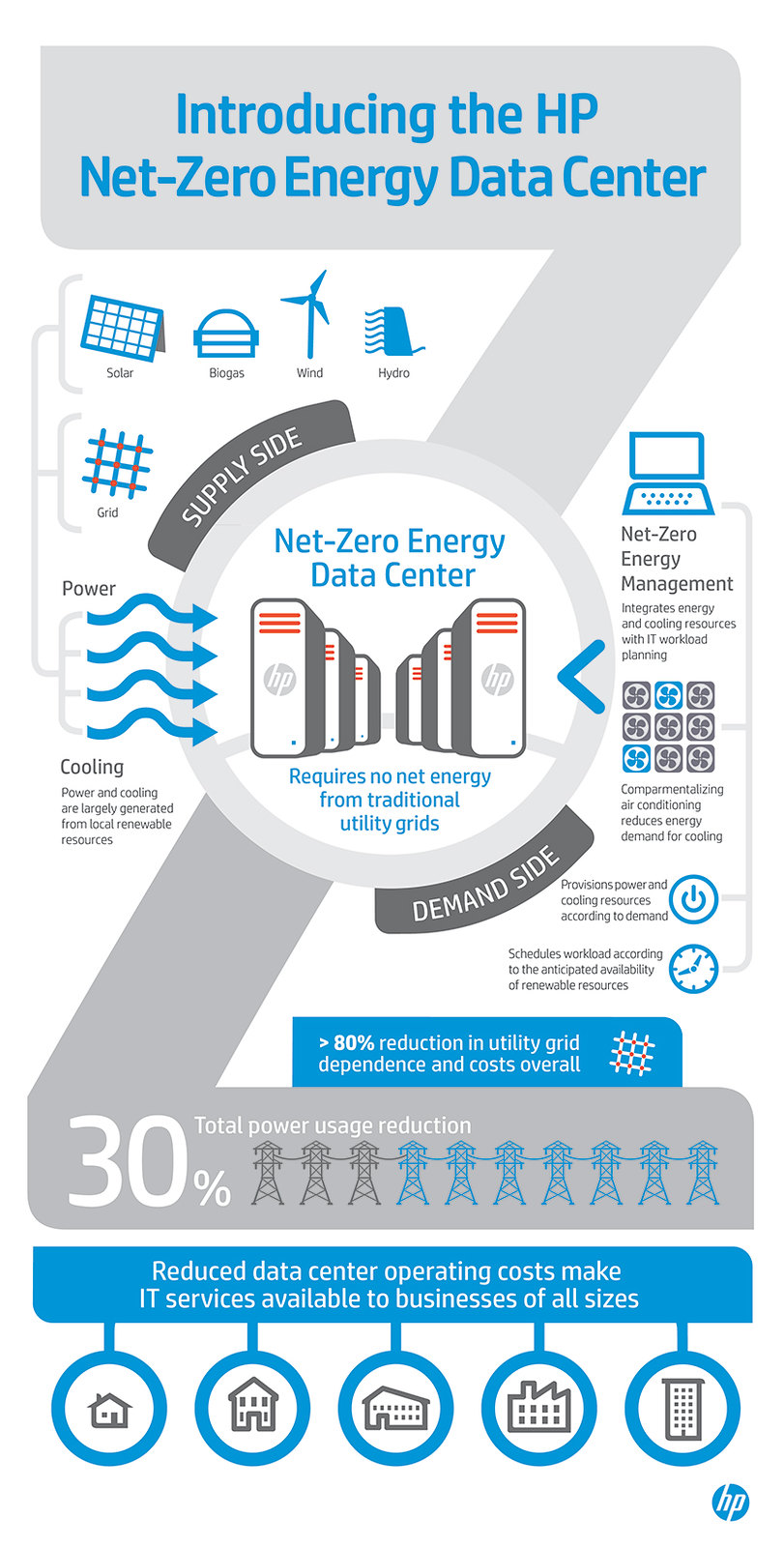
In a recent Press Release HP debuted with an architecture for a Net-Zero Energy Data Center that combines both.
In the HP solution power and cooling are largely generated from local renewable resources, helping to reduce the CEI; schedules, provisions power and cooling resources help to bring the PUE to the ideal 1,0 ratio.


The proposed solution enables organizations to cut total power usage by 30 percent, as well as dependence on grid power and costs by more than 80 percent.


Tuesday, 29 May 2012

Hasbro Sustainability: Since 2002

Having recently looked into NASCAR and it's ongoing efforts to spread EPA program awareness, I thought it might be helpful to see what other firms have adopted sustainable initiatives.

HASBRO has created it's own environmental programs, and has been doing so for quite sometime. Since 2002 Hasbro has been reporting environmental performance of it's US operations when it joined the EPA's Climate Leaders Program (now ceased) to reduce green house emissions. 

Which begs the question that is often asked when companies take on green initiatives; is it a trend?
I recall the BMW 750 HL Hydrogen vehicle early in 2002. Car enthusiast or not,  you could not help but wonder if this was a formidable step forward in a new age of car manufacturing adopting cleaner energy sources to power engines. Because after all, this was BMW, a major player. And it's influence many hoped would influence others.

Saturday, 26 May 2012

NASCAR Takes A Green Lap With EPA

This may seem like an odd pairing but we are certain that NASCAR and the EPA made great moves this past week when they announced a partnership with to build awareness for "environmentally friendly products and solutions to address America’s environmental challenges."

EPA is set to help NASCAR spread awareness for a number of green programs including it's Design for The Environment initiative

Now, if any of this appears to be a little of a surprise you aren't alone. After all, this sport relies on the guzzling of an ethanol based fuel at about 4 MPG. It wouldn't be short sighted to suggest that NASCAR fans are probably not the influencer base for environmentally sound initiatives either, especially if they are driven by government agencies. But rest assured, this isn't the first NASCAR has stepped up to the plate to bat for green technology. Last month the new Ford Focus EV was used to set the pace at the Sprint Cup 400 series at Richmond International Raceway in Virginia. In 2010, 40,000 solar panels were installed over 25 acres at Pocono Raceway in Long Pond, Pa. A number of other NASCAR green tech programs have been launched in the past. 

Electrifying idea on electrification of trucks by Siemens


The 26th International Electrical Vehicle Symposium, held in Los Angeles from May 6th to May 9th, 2012 showcased new and innovative solutions to enable electrification of transport.
One idea we particularly liked dealt with electrification of truck transportation. While most new ideas focus on improving electrification for cars, trucks are often neglected. This is quite unfortunate as trucks are a serious contributor (roughly 29%) to CO2 emission related to transport.

Siemens, the German industry giant, is promoting a different approach to electrify trucks.
The concept introduced at the EVS in LA proposes a hybrid drive. This in itself is not new. However, instead of using a Diesel engine and a battery to save the energy generated, the trucks will get their electricity from overhead lines similar to the ones used for trams and trains.
As long as trucks are using streets equipped with overhead lines providing electricity, trucks are using electricity only. Once they leave the so-called e-Highways, the Diesel engine kicks in to generate electricity to keep the truck running on electricity.

Sounds like a promising idea. Unfortunately details such as how much such an infrastructure would cost and when it could be implemented are not available yet.

Thursday, 24 May 2012

The Tangibility of Corporate Social Responsibility (CSR)


Although the huge trend in his favor, until the past decade. CSR was looked with some suspicious, especially by business people. CSR was faced just as a trend that could not really impact the way the companies do business.

Now things changed. Companies realized that CSR is not just a matter of image but is fundamental to the business survival in the market. Sustainability - to produce more and better products with fewer resources – is now real source to reduce costs and, consequently, increase profits.

In addition, the intangibility that in the past was linked with the word sustainability in the business world is becoming narrower. Some companies developed ways to measure the impact of sustainability on its operations turning more clear to the market the rules of the game.

The era in what CSR was more related with something mystic and intangible, which was used to give a green reputation to corporations, is over.

Friday, 18 May 2012

On biomemetics, concentrated solar arrays, and a clean energy future

We stumbled across this picture earlier today on Facebook, which led us to investigate a fascinating solar array project under way in Spain.

This has primarily to do with the PS10 Solar Array at Seville in Spain, capable of powering 6,000 homes.

More on this project, and related developments, on EarthSky and on The Guardian.